How to Read Banjo Tablature
Learning to read TAB will make it easier for you to learn to play the banjo, and accelerate your progress. It's a lot quicker to look at tablature than to keep rewinding video over and over again.
Please allow the video 5-10 seconds to fully load.

Banjo tablature consists of five lines. The top line represents the 1st string, the 2nd line the 2nd string and so on. The vertical barlines divide the tablature into equal measures of time. The Time Signature tells you how many of each type of note fit into one measure or bar of music. Most banjo music is in 2/4 time, which means you can fit two Square Rolls or two Thumb and Pinches into one measure. A measure of music can also be called a Bar.
A zero on a line means to play an open string. A fretted string is represented by a number.
Which string and which fret to play?

A zero on the top line of the TAB tells you to play the open 1st string. This is normally tuned to a high d note.

A zero on the 2nd tab line means play the 2nd string open. This is normally tuned to a middle b note.

A zero on the 3rd line of the TAB tells you to play the open 3rd, or middle string. This is normally tuned to a g note.

The 4th string makes the lowest sound, so I like to call it the ‘Bottom string.’ It is different from the other strings because it has windings around it, the others are plain strings. The bottom d string is normally tuned to a low d note.
It is represented by the 4th line of the tab.

The shorter 5th string is represented by the bottom line of the tablature. It is normally tuned to a high g note. The fifth string is also called the ‘Thumb String,’ because we only ever play it with the picking hand Thumb.


How Rhythm and Timing is shown in banjo tablature
Some notes are longer than others. There are symbols for every possible length of note you can play, and every kind of rhythm. We are just looking at common banjo rhythms, so we only need a limited set of symbols. With these we can write everything we need for normal banjo music. The notes we are interested in are the Quarter note, 8th note, and 16th notes.

The Quarter note has a stalk but no tail. The 8th note has a stalk and one tail. The 16th note has a stalk and two tails.
Normally the 8th and 16th notes are grouped together to make it easier to read.

The Quarter notes always look the same - they are never grouped together.
The 8th notes are grouped in pairs, and the 16th notes are in groups of four.
For the 8th notes, the single tail becomes a single crossbar; for the 16th notes, two tails become two crossbars.
Eighth notes go twice as fast as quarter notes, so there are two 8th notes for every one quarter note.
Sixteenth notes go four times quicker than quarter notes, so there are four 16th notes for every quarter note.
Quarter notes are also called crotchets.
Eighth notes are also called quavers.
This grouping of notes together is important, it makes it much easier to see where the beat is by reading the tablature. At 5:11 in the video above I demonstrate how the three different types of note sound when played with a standard Bluegrass Boom-Ching rhythm. The first note of each group is the one played on the beat.
NAMES FOR DIFFERENT BANJO RHYTHMS
The Quarter note is the most important, it gives the basic beat of the music. This is normally played by the bass in trad American music and Bluegrass. If you play only one note with the Thumb for each quarter note, this is called Single Thumbing. Quarter notes are also called Crotchets.
The Tempo, or speed of a piece of music is normally specified by stating the number of Quarter notes (Crotchets) per minute. This is normally written like this 108BPM. BPM stands for beats per minute, and one beat is one quarter note – or one crotchet if you prefer the Olde English style.
Eighth notes are also called Quavers, and there are two of them for each Quarter note. When you play Double Thumbing on the banjo, you are playing Quavers (8th notes) with the Thumb.
Sixteenth notes are also called semi-quavers, and there are four of them for each Quarter note. When you play a roll on the banjo, you are playing semi-quavers or 16th notes. Normally you will use a different finger for every consecutive 16th note to make it easier to play. It is hard, even for experienced musicians, to play 16th notes using the same finger over and over.
The Downbeat
Feeling the downbeat is very important, especially if you want to play with other people. Rhythm is one of the most instinctive aspects of music, most people can feel where the beat is.
The first note of any measure (bar) of music has a stronger emphasis. It’s where you count ‘One,’ if you are counting along with the music. In fact, musicians often call the first beat of the bar ‘The One.’ If a professional musician is struggling to join in and play an unfamiliar piece of music, he might say something like ‘I can’t find the one.’ This is especially true with complex rhythms. Once you know where the one, or the downbeat is, it all makes much more sense. It’s how you feel the rhythm of the music.
The first note written to the right of any barline is on the downbeat. If you are playing with a double bass, they will normally play a note at the same time.
PICK UP NOTES
A lot of songs start on the downbeat. However, a lot of songs don’t. Often you will hear a few notes before the first beat, these are called ‘Pick-up notes.’ It’s also called an ‘Anacrucis.’ You can learn more about this in the video at 8:03.
Below is the TAB for the example I play in the video.

Train Rhythm
At 9:01 in the video I show you an example of Train Rhythm. This rhythm is made up of one slower note (a quaver) followed by two quicker notes (semi-quavers). Or you could say one 8th note followed by a pair of 16th notes. You can see these are grouped together under a single crossbar to make it easier to see where the beat is. The first note of each group, the 8th note, has a single crossbar; the two quicker 16th notes have a double crossbar.

Playing with a metronome
A metronome is normally set to produce a certain number of Beats Per Minute (BPM). Each beat of the metronome corresponds to one quarter note, or crotchet.
When you are playing banjo with a metronome, remember that Single Thumbing goes at the same speed as the metronome; Double Thumbing goes at twice the speed; and Rolls go at four times the speed.
Rests
Sometimes you need to leave a gap; not play anything for a short time. It's important to make sure the gap has an exact length of time, so the notes you play before and after the gap are still in good rhythm and timing. This is more important for other instruments and vocals, because of the longer notes and bigger spaces.
On the banjo we mostly play a lot of shorter, quicker notes, so the written sheet music (Tablature) is easier to read. In fact in the Banjo Academy there are hardly any rests written in the TAB. That's because I write everything with the stalks and crossbars system.

The Half Rest fills one entire bar of 2/4 time. 99% of all banjo tablature is written in 2/4 time.
The Quarter Rest is the same length of time as the Quarter Note (Crotchet), of course, and so on.
The only rests that are likely to be important for you to read in banjo tab are the crotchet, quaver, and semi-quaver rests. These are identical with quarter rests, eighth rests and 16th rests.
It’s much easier than you think to read the rests within banjo tablature, because all the notes you play are grouped already. If you think of the bass notes synchronizing with your single Thumb playing, that sets your basic beat or pulse to the music.
Playing in simple time, you can double the number of notes you pick with the Thumb – this is called Double Thumbing. The Thumb picks Eighth Notes which can also be called Quavers. These are shown in banjo tablature normally by pairs of notes with a single crossbar.
You can double up the speed again and play a Roll – this is represented in TAB by the double crossbar, always grouped in sets of four, called sixteenth notes or semi-quavers. This is to make it clear these four notes are played in the same time as one crotchet, or normal bluegrass bass note.
Get more help learning to play the banjo.
There's nothing like doing it yourself to learn quicker! Get your banjo out and try playing these simple techniques that every top player does, and a great place to start playing the banjo.
The basic Single Thumb fingerpicking pattern is a great way to accompany yourself singing, or even jam along with other people. It's one of the Basic Building Blocks of Bluegrass.
Once you make a connection between the Single Thumbing, the Double Thumbing and the Rolls, you can play with a Bluegrass Band!

Introduction to Old-Time Banjo Fingerpicking - Single Thumb
Click to go to a new page with a video showing basic Single Thumbing on the banjo. You will also learn about some of the pioneers of banjo picking, like Charlie Poole and Roscoe Holcomb.
Use the video bookmarks to go straight to the teaching content if you want to learn Old-Time Single Thumb banjo picking immediately (Free video).
You will learn the Single Thumb / Pinch pattern which is used for backup in all Bluegrass music as well as the Old-Time fingerpicking styles.
In this style of playing the Thumb plays Quarter Notes or Crotchets. These are never grouped together in the TAB.
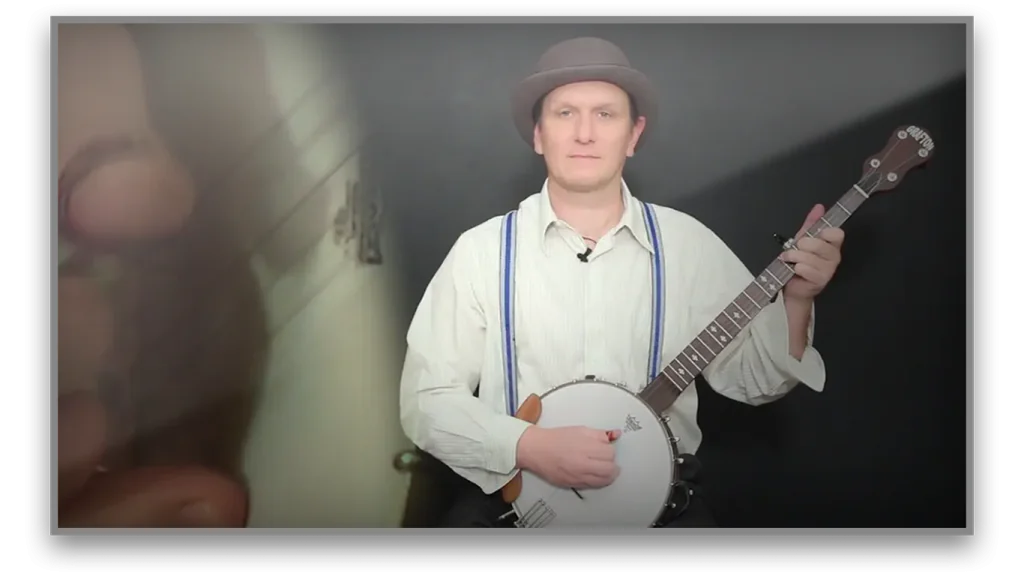
Click to go to a new page with a free video. Learn how to add a few notes of Double Thumbing on top of the Single Thumb /Pinch technique you learnt in part 1.
You can recognise Double Thumbing in TAB because you will see the single crossbar meaning eighth notes (Quavers) and also there will be a capital ‘T’ written under each note to indicate it is played with the Thumb of the picking hand. These notes are grouped in pairs in the tablature.

Click here to go to a new page and learn the Square Roll. You will continue to pick Double Thumbing speed with the Thumb, and add an extra note in between each Thumb note with one of the fingers, either the Index or Middle. This is one way to play a Roll.
These rolling notes are represented by the double crossbar in the TAB. The notes are called sixteenth notes or semi-quavers.
Add a comment
Let me know what you think of this new page. I'd love to hear your feedback.