Please allow the video 5-10 seconds to fully load.
Banjo – a brief history
Africans have been playing a string attached to a drum since the dawn of time. Nobody knows for sure what were the origins of this instrument consisting of a drum, a string, a stick to hold the string in tension and a bridge to transfer the vibration of the string to the drum skin.
Banjo videos from Bill Evans and Joff Lowson
Bill Evans is a fine player, teacher, and historian of the banjo. I was very proud to be featured alongside him in BluegrassToday.com
We have a couple of videos of banjo music to share, contributed by two prominent instructors of the five string from opposite sides of the planet.
First up is Bill Evans, who created this lovely arrangement of My Favorite Things played by he and his wife, Babi…
Now we hear from Joff Lowson, who runs his own online Banjo Academy from his home in Bristol, England. His video is a solo arrangement of his original tune, Penny, dramatically captured in the mountains near Andalusia in Spain.
Joel Sweeney was the first star performer on the banjo in the 1800s. It’s often said that he invented the modern banjo by adding frets to the neck and also introducing the fifth string, however many people question these claims nowadays. As well as four conventional strings, there is a unique feature not found on any other musical instrument – a shorter fifth string attached to a tuning peg fitted halfway up the side of the neck. This ‘Fifth string’ is responsible for much of the distinctive sound of the banjo. Nearly all string instruments have the strings fitted in order of pitch from highest-sounding to lowest-sounding but the fifth string is not only a different length from the other four strings it is also placed out of order – the fifth string is the highest string on the banjo and it is positioned where you would normally expect the lowest string to be.
This unique arrangement of the strings has led to many different playing styles being developed. The technique of playing a five-string banjo is quite different to the technique of playing other stringed instruments such as the guitar or the mandolin.
Classical Banjo
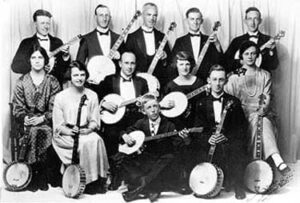
The five-string banjo was very popular in the late 1800s and early 1900s and many pieces of music and 78rpm records survive from this time. This is referred to as ‘Classical banjo.’ A classical banjo player picks the strings in exactly the same way as a classical guitar player. Believe it or not, the banjo was far more popular than the guitar. There were even banjo orchestras! Banjos at this time nearly all used gut strings instead of steel and the drum skins were made of thin animal hide which was very fragile and tended to break. A banjo sounds better and louder when the head is tight and in the days before plastic skins were invented it was very hard to get the head tight enough to sound good without breaking it. A lot of professional banjo players used to have a spare banjo in case a skin broke during the show!
Jazz Banjo
In the 1920s an exciting new form of music known as ‘Jazz’ started to become very popular, and the banjo was much in demand as a rhythm instrument, mainly because the banjo is quite loud when strummed aggressively and the sound cuts through a group of trumpets, trombones, saxophones and drums. Players adapting to this new style of playing quickly found that the fifth string got in the way and removed it, and pretty soon manufacturers started making banjos with only four strings. Nearly all the banjos made in the 1920s and 1930s are four-stringed instruments. Around 1930 the electric guitar was invented which is louder than the banjo and does not suffer from problems with skin breakage. To start with the electric guitar was very expensive and only the best orchestras could afford them, but during the ‘Big band’ era of the 1940s as orchestra got larger and larger it became more and more difficult to hear the banjo and the electric guitar eventually replaced it. By 1950 the banjo had almost vanished from popular music and the Rock and Roll era had begun. For the next fifty years the most popular acts consisted of electric guitars, bass, drums and vocals with keyboards and sometimes a brass section.
Bluegrass Banjo
Earl Scruggs was born in 1924 and when he was still a child he invented a completely new way of playing the five-string banjo. Earl Scruggs’ style consists of playing ‘Roll’ patterns with the thumb and first two fingers of the right hand, often called ‘Three finger picking.’ One of his most important innovations was the use of ‘picks’ which are little metal or plastic contraptions that fit onto the ends of the fingers and thumb and allow you to play with more precision, speed and power than the bare finger or fingernail used by classical players. Scruggs made his professional debut at the age of 16 in Nashville and was an immediate sensation. His style of banjo playing is often called ‘Bluegrass’ in honour of the first band he played in, the Bluegrass Boys.
Old-Time Banjo
Nowadays the old-time ‘Clawhammer’ or ‘Frailing’ style of playing the five-string is becoming increasingly popular. This method of playing is almost the opposite of Scruggs or classical style – the fingers play with a downward motion instead of picking upwards. Some of the best banjo players are able to do both. The four-string banjo is still very popular in Irish traditional music and is played with a plectrum, much like a guitar. There is a lot of cross-over between styles these days. Some of the best Irish players are able to replicate the Scruggs sound using a plectrum-based technique, and likewise some of the best Bluegrass players are able to play Irish tunes using their fingerpicks.
Learn to play the banjo
Free online video lessons – Everything you need to get started playing the banjo. Click below to get started today.
“Thousands of beginners & musicians alike now play who never thought they could.”
Discover my revived 3—finger banjo technique. If you practice daily, you can play any banjo song you want.
It’s not just possible—it’s easy using these simple hand positions.
Most banjo books try to make you run before you can walk. That can often put people off. I’ll tell you now if you practice using what I show you in the academy—you’ll be able to play almost any song you want. Click below to get access today