How to Tune a Banjo
Make your banjo sound good
By checking the tuning every time you play
Tuning a banjo with an electronic tuner.
Please allow the video 5-10 seconds to fully load.
The easiest way for a beginner to tune a banjo is by using an electronic tuner. Watch this free video to learn how.
Why do I need to tune my banjo?
A banjo that is ‘In tune’ sounds good. It doesn’t matter if you are a beginner or a professional, you are not going to sound good if your banjo is out of tune. You should always check the tuning every time you play.
Learning to Tune a Banjo
You tune the banjo by adjusting the tuning pegs.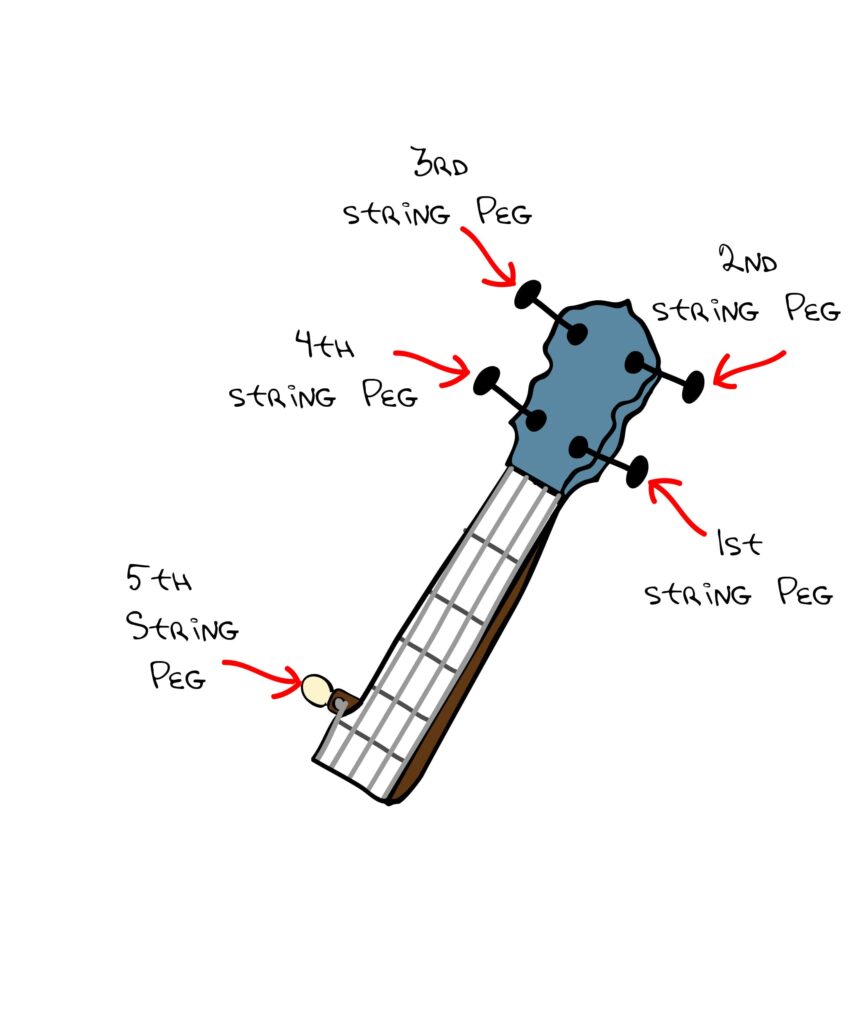
Normally you only need to turn the tuning peg a small amount to change the tuning. To start with, turn one of the tuning pegs a small amount and play the string at the same time. See if you can hear whether the pitch of the note is going up or down as you rotate the peg. Once you can tell if the note is going up or down, you’re ready to try and tune the banjo.
Start by tuning one string, then when you are happy with that, try a different string. The tuning peg might work the opposite way on a different string!
When the string is close to the correct pitch, you will need to adjust the peg by a tiny amount. It will take practice to be able to put just the right amount of pressure onto the key of the tuning peg and to feel when the peg has turned just the right amount. Don’t worry, you will quickly get better with practice and experience.
Keep your face away from the banjo while you are tuning, just in case you break a string.
The 1st string is tuned to a d and is closest to the ground
The 2nd string is tuned to a b
The 3rd string is tuned to a g and is in the middle
The 4th string is tuned to a low d and is sometimes called the bottom string because it makes the lowest note.
The 1st, 2nd, 3rd and 4th strings are called the long strings.
The 5th string is tuned to a high g and is the closest to the sky. It is shorter than the long strings. It is also called the Thumb String, because it is only ever played by the RH Thumb.
What does 'Sharp' and 'Flat' mean?
When the pitch of a note is higher than it should be, we call that ‘Sharp.’ When the pitch of a note is lower than it should be, we call that ‘Flat.’
If you are jamming with some experienced musicians they might say, for example ‘I think your 3rd string is a little flat, you should come up a bit.’ Or ‘Your 5th string sounds a tad sharp.’
Unfortunately these words are also used in a completely different way, to give names to notes that lie between letter names like c and d. You can learn more about that further down the page.
Matching pairs of notes
A quick way to check your tuning
Open 1st string is the same note as 2nd string 3rd fret
Open 2nd string is the same note as 3rd string 4th fret
Open 3rd string is the same note as 4th string 5th fret
Open 5th string is the same note as 1st string 5th fret
You can see in the video above at around 9 minutes I am demonstrating what happens if you tune a string to the wrong note. In this example, I’m tuning the 1st string to a d# note. At a certain point (9:50) I get lost, I can’t tell whether I’m too high (Sharp) or too low (Flat) and I can’t see the tuner very well. So I play a note on the 2nd string 4th fret so I can find my bearings.
Your Banjo is Badly Out of Tune?
If your banjo is a long way out of tune, it’s going to take a while to tune it up properly. Tune all the strings as best you can then start again. It often takes two or three times round to get a musical stringed instrument properly in tune. This is the same for experienced professional musicians as it is for beginners, and also beware that the tuning can change with temperature and humidity, so even if your banjo was perfectly in tune yesterday it’s a good idea to tune it again today!
The more you practice tuning your banjo, the better you’re going to get at the hand skills and also the listening skills.
Tuning to the wrong note
An easy mistake to make
When you are concentrating on the electronic tuner and trying to get that green light, it’s easy to forget which note you are tuning to. A chromatic tuner is capable of tuning to any of twelve different notes, not only the notes you need for G standard tuning.
A common mistake that beginners make is to tune to the wrong note. This will leave your banjo sounding terrible and everything you play will sound wrong! This could be doubly confusing if you’ve taken time to tune the instrument and think you have a solid green light on each string.
That’s why it’s important to know the note names for every string. Most tuners will give some kind of read out to say which note you are tuning to, as well as whether the note is sharp, flat, or in tune. Make sure to check the readout on the tuner and confirm that it’s the correct note for the string you are tuning.
I once saw a band playing at a festival and the bass player had tuned his 2nd string to the wrong note! He had tuned to a d# instead of a d! The band started out playing confidently and with enthusiasm, but the longer they went on, the more everyone realised there was something wrong!
This is one reason why it’s so important to keep listening carefully when you are tuning. Don’t just rely on the electronic tuner to give you the right results, make sure to use your ears and brain as well.
More information about electronic tuners
There are several different kinds of electronic tuner. The most popular type for use with banjos is the one that clips onto the peghead. These are made by many different companies. There’s also the type which uses a microphone, so you have to hold it in front of the banjo head (drum skin) which can be tricky. You could rest it on a table as well.
Finally there’s the type that you have to plug into with a cable. These are most commonly used for electric guitars, so the only way you can use one of these with a banjo is if you have a pickup fitted. Note that some tuners work two ways e.g. clip on and mic.
Another important factor to bear in mind when purchasing a tuner is whether it is chromatic or not. A chromatic tuner can detect any of the twelve notes including the sharp # and flat Ƅ notes. These tuners are also called universal tuners. There are many advantages to this type.
The opposite of a chromatic tuner is one that only detects a limited range of notes. These are usually called guitar, bass or ukelele tuners. This type of tuner is normally only capable of detecting five notes g d a e b. These are the notes that the strings of the guitar are normally tuned to, and basses and ukeleles are generally tuned to these notes as well. Fortunately the notes of the banjo in standard G tuning are included, so these tuners work with banjo!
The advantage of a non-chromatic tuner is that you don’t need to understand anything about the sharp and flat notes explained directly above here, so that can be helpful for a complete beginner. However the disadvantage is that you will only be able to tune to standard g tuning.
Although everything on this website is currently in standard tuning, there are other tunings you might like to use, including for example C tuning. For that you will need a chromatic tuner.

The One Secret To Easily Play The Banjo Songs You Love Fast, Even If You've Never Picked Up The Instrument Before!
WATCH HOWWhat are the banjo note names?
We use the words 'Sharp' and 'Flat' to mean something else entirely...
There are twelve possible notes you can play, not only on the banjo, but on any musical instrument. Only seven of these have letter names. We use the first seven letters of the alphabet a b c d e f g as names for notes. You already know that the open strings of the five string banjo are normally tuned to the notes g (x2), d (x2) and b.
Most of the letter-named notes are two frets apart. For example the third string open is called g, and if you fret it on the 2nd fret that gives you an a, with the 4th fret giving you a b. So what do we call the note on the 3rd string 1st fret? That’s called g sharp, which is written with a special symbol like this g#. This is called ‘The sharp sign’ in music, it’s also called the hash sign or pound sign in other situations.
This is not the same as being out of tune by being a little bit sharp! G sharp is a proper note in its own right, and it’s possible, and important, to play the g# in tune if you need to use it. Most of the songs in the banjo academy use the simple left hand positions so you don’t need to understand any of this to be able to play great music on the banjo.
However it’s important to know about sharp notes if you are using a chromatic tuner.
This is a very deep subject and I’m not going to go into too much detail here. As a beginner, you just need to know that, for example:
a# is the note between a and b
There is no b#
c# is the note between c and d
d# is the note between d and e
There is no e#
f# is the note between f and g
g# is the note between g and a
So g# is the note one fret (also called a semitone) above g. There is also a flat sign, which looks like a special letter b, like this:
Ƅ
So a b flat, written like this bƄ, is the note one fret below b. So:
aƄ is the note between g and a
bƄ is the note between a and b
There is no c flat
dƄ is the note between c and d
eƄ is the note between d and e
There is no f flat
gƄ is the note between a and g.
So we have seven letter names for the notes a b c d e f g, and there are five other notes, each of which has two names.
aƄ is the same note as g#
bƄ is the same note as a#
dƄ is the same note as c#
eƄ is the same note as d#
gƄ is the same note as f#
Tuning the banjo by ear
Learn to tune by ear as well as using an electronic tuner
It’s really important to develop your sense of pitch, i.e. being able to tell whether your banjo is in tune or not. The electronic tuner is a really useful tool and it’s highly recommended for beginners, but it’s equally important to learn to tune by ear. If you make sure to check your tuning every time you play, you will quickly learn what ‘In tune’ sounds like.
The electronic tuner is only a machine, it doesn’t have any appreciation of music. The human ear is far more sensitive. Tuning by ear, you can go beyond what is possible with the tuner. When you listen to any great musician playing, you are listening to their unique and highly developed sense of tuning, as well as the notes and rhythms they play.
For example classical musicians playing in an orchestra will mostly tune by ear to get that refined sound. The tiniest tweak of a tuning peg can make a big difference to how something sounds.
Another reason to tune by ear is because you want to play along with people who are not in ‘Concert pitch.’ This means that a musical instrument can be in tune with itself, but not in tune with a tuning device.
A lot of classic records from the 50s, 60s and 70s were recorded before electronic tuners were invented. They tuned by ear, and they tuned to each other. So the 3rd string of the banjo might be a little bit flat (low) compared to the electronic tuner. If every string is exactly the same amount flat, then the banjo is still in tune, it’s just tuned to a different pitch. We say the banjo is ‘In tune with itself.’
If you want to play along with classic old records, you are going to have to learn to tune by ear. For example a lot of old Flatt and Scruggs records are tuned up by a semitone, so the banjo is tuned to g# d# g# c d#.
Develop your musical ear
play our free interactive tuning game
The tuning game will play you a pair of notes and you have to decide whether one is higher or lower in pitch than the other.
The first note you hear is always a g, the 3rd string, and the second note is either higher or lower (sharp or flat).
The game is played over six rounds. In the first round the first note you hear is, as always, a g, and the second note is either a g# or a f#. So by getting the correct answer on the first round, you can develop the skill needed to hear whether you are tuning you banjo to the correct note, as demonstrated in the video above.
In the second and subsequent rounds, the first note you hear will still be a g, but the higher or lower note will get progressively closer in pitch to a g.
By the time you get to the 6th and final round, it will take keen listening skills to determine whether the second note is higher or lower than the first note.

Learn how to tune the banjo with the Tuning Game!
Practice tuning and refine your musical ear with this online resource…
The tuning game is a simple game that helps you recognise different pitches in a note. By training this pitch sensitivity you’re able to easily hear if you have to tune the banjo up or down based on the pitch.
Go ahead and click below and practice tuning with the tuning game.
Learn to tune banjo by ear
watch this free video
Please allow the video 5-10 seconds to fully load.
In this video, I show you how to tune a banjo by comparing each string to the sound of a piano. My assistant Ticketyboo plays a note on the piano then I demonstrate how the banjo sounds when it is sharp or flat.
Practical skills
There are two sets of skill you need to master here, one set of listening skills and another set of practical skills. It’s really not difficult to learn the mechanical skills involved in tuning a banjo and this video will show you how!
The pegs do not always rotate the same way on different banjos or even on different strings on the same banjo. If you have to replace a string, make sure to wind the string around the tuning peg the same way because that will affect the direction of rotation as well!
Listening Skills
Once you’ve worked out how to adjust a string up or down this video teaches some of the listening skills needed to tune a banjo by ear. The piano note is always right and Joff demonstrates a few dozen notes which are out of tune with the piano by a different amount.
Some of the notes in this demonstration are quite close to the correct pitch, some are quite a long way out of tune. If you can tell how far apart the banjo and the piano note are, you are learning an important listening skill.
If you are completely new to playing the banjo the most important thing is to determine whether the banjo note is higher or lower than the correct note so you can work out which way to turn the peg. The best way to learn this skill is by playing our interactive tuning game!
Tuning Banjo Guitar & Fiddle
If you have a buddy who plays the guitar or the fiddle, they have g and d strings too so you can tune to them.
On the guitar the two middle strings (3rd and 4th strings) are a g note and a d note which are the same as the 3rd and 4th strings on the banjo. So if your buddy’s guitar is in tune you can tune to that but make sure to match the correct strings on your banjo to the strings on their guitar.
The two lowest strings of the fiddle are a match for two strings on the banjo, this time the fourth or bottom string on the fiddle is the same g note as the middle 3rd string on the banjo. The 3rd string on the fiddle is a match for the 1st string (d) on the banjo.
Pitch Recognition
Another important listening skill is called pitch recognition or perfect pitch which just means learning to recognise the sound of notes so you can hear if a note is right or wrong.
The banjo is a marvellous instrument for developing these skills because it is tuned to an open G chord and just by playing a banjo you can learn pitch recognition skills that might be harder to learn on other instruments such as a saxophone or violin – as long as you always tune your banjo before playing!
The banjo is also conveniently pitched in the middle of the normal musical range. Anyone can sing along with a banjo. For most women the higher strings on the banjo match their normal singing range, and most men will find the lower strings on the banjo comfortable to sing along with.
Try singing the notes as well. Pluck any string and try to find that note with your voice. If you can match the note by singing it, you can surely match it by turning a peg!